The six books, and how they connect
Every peso Kuting Kitchen earns or spends is written down once, in the right book, then carried forward until it becomes a line on a BIR return. Here's the map.
← 3.2 Debit and credit in plain wordsSix books, one job each
BIR expects every business to keep books of accounts. For a business like Kuting Kitchen, that's six: the sales journal, purchase journal, cash receipts journal, cash disbursements journal, general journal, and the general ledger.
The five journals record things as they happen. The ledger collects them by account.
It always starts with a document
Nothing goes into the books without proof: a sales invoice, a supplier's invoice, a payout statement, a receipt for a payment, or a note explaining an adjustment.
The document tells you which book to use.
Sales go in the sales journal
Every invoice Kuting Kitchen issues, like the ₱480 Shopee order, is recorded in the sales journal: who bought, the invoice number, the sale and its VAT.
Bought now, pay later: the purchase journal
When a supplier delivers ₱6,720 of cat food with an invoice and Kuting Kitchen will pay at the end of the month, it goes in the purchase journal.
Paid on the spot instead? Then it's money out, two steps from now.
Money in: the cash receipts journal
Every peso that arrives, like Shopee's ₱405.86 payout, goes in the cash receipts journal, with the fees and tax withheld broken out.
Money out: the cash disbursements journal
Every payment, like ₱28,500 to the landlord (₱30,000 rent less ₱1,500 withheld), goes in the cash disbursements journal, with the receipt or invoice behind it.
Everything else: the general journal
Each transaction goes in one journal only. The ₱480 sale is in the sales journal, and you don't copy it into the general journal too.
| A sale you invoiced | Sales journal |
|---|---|
| A purchase you'll pay later | Purchase journal |
| Money in | Cash receipts journal |
| Money out | Cash disbursements journal |
| Anything else | General journal |
"Anything else" means month-end adjustments, the year-end stock count and corrections. If the payout entry left out the ₱72 Shopee fee (Lesson 3.2), the fix goes in the general journal.
The journals post to the ledger
At month-end, the journals' totals are posted to the general ledger, which keeps one running page per account: Cash, Receivable from Shopee, Sales, Output VAT, Input VAT, Rent, and so on.
The journals say what happened when. The ledger says where each account stands.
From the ledger to BIR
The ledger's balances make the trial balance (a check that debits equal credits), then the financial statements. The same balances give the numbers for BIR returns: output and input VAT for the 2550Q, sales and expenses for the 1702Q.
Get the first step right, and every step after it follows.
Sample: the trial balance
A trial balance lists every account in the general ledger with its balance: debits on the left, credits on the right.
Kuting Kitchen's for the quarter ending 30 September 2026 totals ₱1,704,500 on both sides, so the books balance. That doesn't prove every entry is right (an amount in the wrong account still balances), but if the totals differ, something is missing.
Sample: the financial statements
The trial balance splits in two. Income and expense accounts make the income statement: ₱1,200,000 of sales less ₱1,038,000 of costs leaves ₱162,000 before tax.
The rest make the balance sheet: what the business owns (₱666,500) equals what it owes plus what belongs to the owner.
Kuting Kitchen sells more than ₱3 million a year, so its annual statements must be audited by an independent CPA, who signs the audit report. Carla, the owner, signs a statement that the figures are management's. They're filed with the annual income tax return.
Sample: the 2550Q
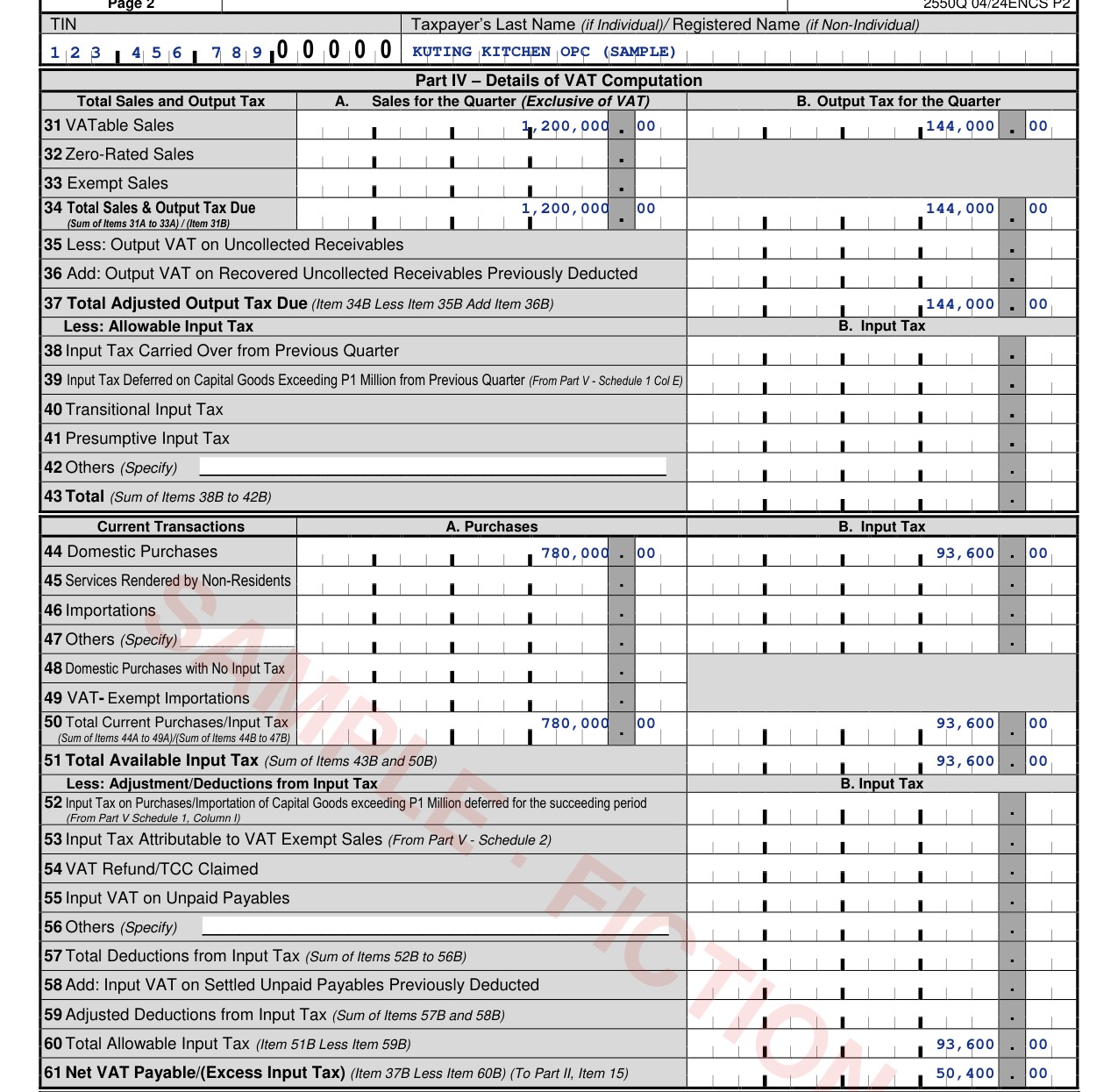
This is BIR's real quarterly VAT return (Form 2550Q, April 2024 version), filled in with Kuting Kitchen's sample numbers.
Item 31: ₱1,200,000 of sales and ₱144,000 output VAT. Item 44: ₱93,600 input VAT on purchases. Item 61: ₱50,400 to pay. Both VAT figures come straight from the trial balance.
Sample: the 1702Q
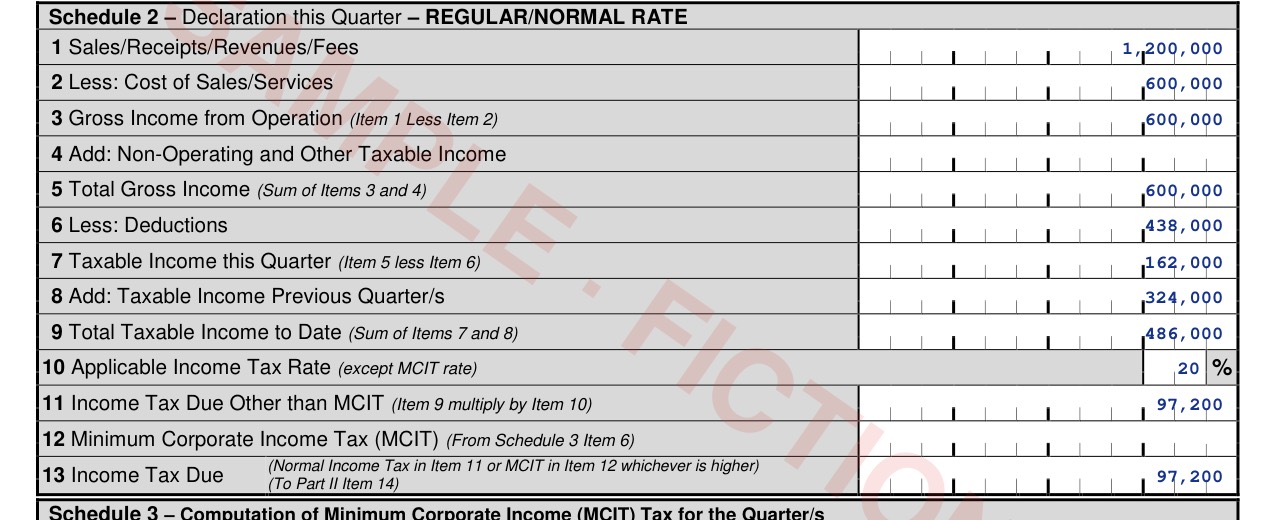
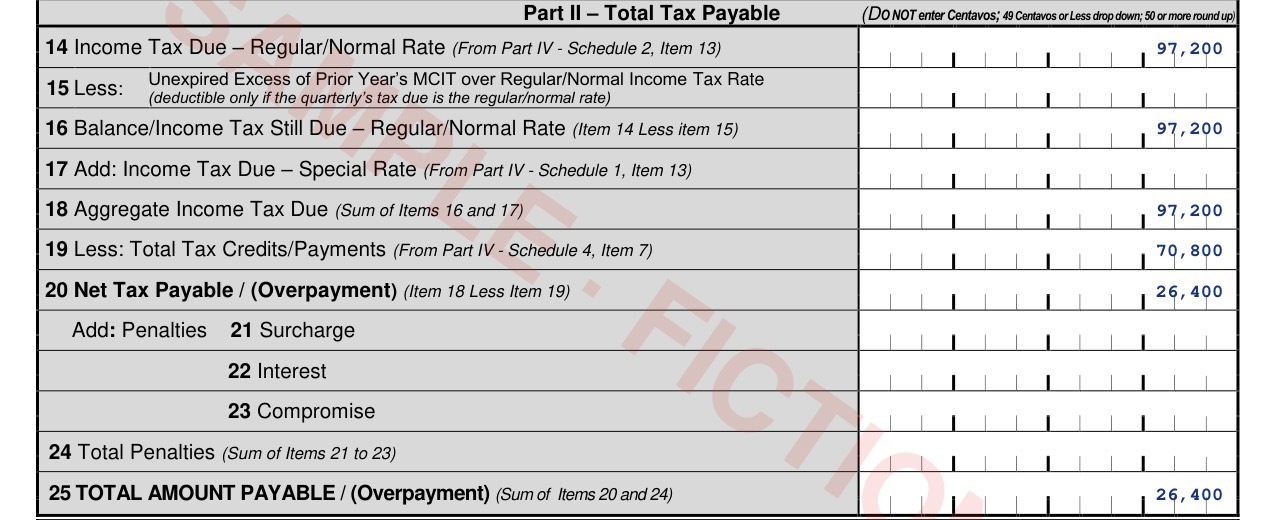
The quarterly income tax return (Form 1702Q) takes the income statement: sales ₱1,200,000, cost ₱600,000, deductions ₱438,000, ₱162,000 taxable this quarter.
It counts from January, so earlier quarters are added and earlier payments taken off: ₱26,400 to pay. Lessons 4, 6 and 7 go through both forms line by line.
General information for learning, not tax advice. Kuting Kitchen and its numbers are fictional. Which books a business keeps depends on its registration; check your RDO's requirements.
Ready to check what you learned?
3 quick questions on the next page. Pick an answer to see why.
Take the check →